Search This Blog

Wednesday, April 9, 2025

Era nga bwe mwagala abantu okubakolanga, nammwe mubakolenga bwe mutyo. Lukka 6:31

“N’olwekyo, ng’abantu ba Katonda abalonde, abatukuvu era abaagalwa ennyo, mwennyambe n’okusaasira, ekisa, obwetoowaze, obuwombeefu n’obugumiikiriza. Mugumiikiriza munne era musonyiwe munne singa wabaawo omu ku mmwe alina okwemulugunya ku muntu. Musonyiwe nga Mukama akusonyiwa. Era empisa zino zonna ziteeka ku kwagala, ekiba kikwatira wamu byonna mu butuukirivu.” —Abakoolosayi 3:12-14 .


“Abaganda ne bannyinaffe, tebavumagana. Omuntu yenna ayogera ku muganda we oba mwannyinaffe oba abalamuzi ayogera ku mateeka n’asala omusango. Bw’osala omusango gw’amateeka, oba togukuuma, wabula otudde mu kusalawo ku nsonga eyo.” —Yakobo 4:11.Bya Rev Samuel Muwonge .


Rev. Samuel Muwonge

Lenten Reflection Day 36 And who is the burden-bearer in 1 Peter 5:7?

It is the Lord. The Lord, gracious and loving. The Lord, strong and wise. The Lord, the Creator and sustainer of all things. The Lord, like whom there is no other. This is the invitation we are given. It’s not just to fling off our burdens into nothingness or onto someone barely more capable than we are – it is to cast them on the Lord.

In those terms, then, casting is not just a command; it’s an act of logic! Why would we try and bear the weighty, complicated, troubling burdens of life when there is someone so much more equipped to bear them?

Why would we insist on hanging onto that which is better handled by another?

In that light, perhaps our refusal to cast our burdens on the Lord is more about our own pride and desire for control than it is about either the weight and complication of the burdens themselves or the ability of the Lord to handle them.

Right now, Christian, what burden are you bearing that feels too heavy? Too complicated? Too much in every way? There is another better equipped to bear it. If we will trust Him enough to do so. Psalm 55:22. Just cast to Him for am sure he cares. 

Rev Samuel Muwonge.

Monday, April 7, 2025

Construction of vestries at St. Stephen's Kitende on a steady path of progress.

Construction of offices/vestries at St. Stephen's Church of Uganda Kitende is smoothly going on.

The white clay bricks from Butende used for construction of the Church walls have given the Church structure a unique appearance amongst the buildings in the area.

We thank God for the provision of funds used to turn His house of worship into a better and magnificent building.k

More of your financial support is needed to enable us complete this work preferably before the end of this year.

"Go up into the mountains and bring down timber and build my house, so that I may take pleasure in it and be honored,” says the LORD. Haggai 8:1

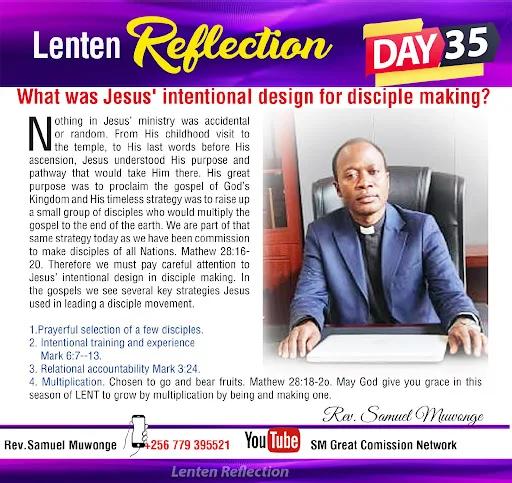
LENTEN Reflection day 35. What was Jesus' intentional design for disciple making? Nothing in Jesus' ministry was accidental or random. From His childhood visit to the temple, to His last words before His ascension, Jesus understood His purpose and pathway that would take Him there. His great purpose was to proclaim the gospel of God's Kingdom and His timeless strategy was to raise up a small group of disciples who would multiply the gospel to the end of the earth. We are part of that same strategy today as we have been commission to make disciples of all Nations. Mathew 28:16---20. Therefore we must pay careful attention to Jesus' intentional design in disciple making. In the gospels we see several key strategies Jesus used in leading a disciple movement.1.Prayerful selection of a few disciples.2. Intentional training and expereiencemark 6:7--13.3. Relational accountability mark 3:24.4. Multiplication. Chosen to go and bear fruits. Mathew 28:18--2o. May God give you grace in this season of LENT to grow by multiplication by being and making one.Rev Samuel Muwonge.


 ministry was accidental or random. From His childhood visit to the temple, to His last words before His ascension, Jesus understood His purpose and pathway that would take Him there. His great purpose was to proclaim the gospel of God's Kingdom and His timeless strategy was to raise up a small group of disciples who would multiply the gospel to the end of the earth. We are part of that same strategy today as we have been commission to make disciples of all Nations. Mathew 28:16---20. Therefore we must pay careful attention to Jesus' intentional design in disciple making. In the gospels we see several key strategies Jesus used in leading a disciple movement.
1.Prayerful selection of a few disciples.
2. Intentional training and expereiencemark 6:7--13.
3. Relational accountability mark 3:24.
4. Multiplication. Chosen to go and bear fruits. Mathew 28:18--2o. May God give you grace in this season of LENT to grow by multiplication by being and making one.
Rev Samuel Muwonge.


Nothing in Jesus' ministry was accidental or random. From His childhood visit to the temple, to His last words before His ascension, Jesus understood His purpose and pathway that would take Him there. His great purpose was to proclaim the gospel of God's Kingdom and His timeless strategy was to raise up a small group of disciples who would multiply the gospel to the end of the earth. We are part of that same strategy today as we have been commission to make disciples of all Nations. Mathew 28:16---20. Therefore we must pay careful attention to Jesus' intentional design in disciple making. In the gospels we see several key strategies Jesus used in leading a disciple movement.
1.Prayerful selection of a few disciples.
2. Intentional training and expereiencemark 6:7--13.
3. Relational accountability mark 3:24.
4. Multiplication. Chosen to go and bear fruits. Mathew 28:18--2o. May God give you grace in this season of LENT to grow by multiplication by being and making one.
Rev Samuel Muwonge.


Kiki Yesu kye yakola mu bugenderevu mu kulonda abayigirizwa?


Tewali kintu kyonna mu buweereza bwa Yesu kyali kya butanwa oba nga kya kimpowooze. Okuva ku kukyala kwe okw’obuto mu yeekaalu, okutuuka ku bigambo bye ebisembayo nga tannalinnya, Yesu yategeera ekigendererwa kye n’ekkubo lye ebyandimutwaliddeyo. Ekigendererwa kye ekinene kyali kya kulangirira Enjiri y’Obwakabaka bwa Katonda era akakodyo ke akataggwaawo kaali ka kusitula ekibinja ekitono eky’abayigirizwa abaali bagenda okukubisaamu enjiri okutuuka ku nkomerero y’ensi. Tuli kitundu ku nkola eyo yennyini leero nga bwe tubadde akakiiko okufuula abayigirizwa b’amawanga gonna. Mathew 28:16-20. N’olwekyo tulina okussaayo omwoyo n’obwegendereza ku nteekateeka ya Yesu ey’ekigendererwa mu kukola abayigirizwa. Mu Njiri tulaba obukodyo obukulu obuwerako Yesu bwe yakozesa mu kukulembera ekibiina ky’abayigirizwa.


1.Okusunsulamu abayigirizwa abatonotono.

2. Okutendekebwa mu bugenderevu n’obumanyirivu . 

    Makko 6:7--13.

3. Akabonero k’obuvunaanyizibwa obw’enkolagana 3:24.

4. Okukubisaamu. yalondebwa okugenda okubala ebibala. Mathew 28:18-2o. Katonda akuwe ekisa mu sizoni eno ey’Ekisiibo okukula ng’okubisaamu ng’obeera era ng’akola ekimu.

Rev. Samuel Muwonge


Sunday, April 6, 2025

Okufumiitiriza ku kisiibo Olunaku 34

 Ebisumuluzo bya Katonda okuyingira  mu nsonga zo .
Okuyingira mu nsonga z’obwakatonda kintu ekibaawo nga Katonda yeenyigira nnyo mu kukyusa embeera ezimu mu nsonga z’abantu. Mu kiseera kino  eky’Ekisiibo n’omwaka gwonna nsaba ofune okuyingira mu kuyingirira okw’obwakatonda byonna by’oyitamu nga Peetero bwe yakola, nga Lazaalo ,Danyeri n'abalala. Okuyingirira okw’obwakatonda kye kikolwa kya Katonda ekiyingira mu nsonga z’obuntu, emirundi mingi mu ngeri etasuubirwa era ey’ekyamagero. Kye kwolesebwa kw’amaanyi ga Katonda, okwagala, n’obufuzi bwe.
Ebisumuluzo by’okuyingira mu nsonga z’obwakatonda bye bino:

1. Okutegeera obukulembeze bwa Katonda .
“Kubanga ebirowoozo byange si bye birowoozo byo, n’amakubo gange tegali, bw’agamba Mukama.Kubanga ng’eggulu bwe liri waggulu okusinga ensi, n’amakubo gange gali waggulu okusinga amakubo go, n’ebirowoozo byange okusinga ebirowoozo byo” (Isaaya 46:9-10).

Tulina okutegeera obufuzi bwa Katonda era ne tukkiriza nti amakubo ge ga waggulu okusinga agaffe, nga twesiga amagezi ge agataliiko kkomo n’amaanyi ge.

Kikwata ku kumanya nti Katonda ye Mutonzi era omufuzi w’obutonde bwonna era nti enteekateeka ze n’ebigendererwa bye bulijjo biba birungi, ne bwe tuba nga tetusobola kubitegeera.

Bwe tutegeera obufuzi bwa Katonda, tusobola okuwummulamu mu magezi ge n’enteekateeka ye, nga twesiga nti bulijjo akola ku lw’obulungi bwaffe.

2. Weesige obulungi bwa Katonda .
“Era tukimanyi nti ebintu byonna bikolera wamu ku lw’obulungi eri abo abaagala Katonda, eri abo abayitibwa ng’ekigendererwa kye bwe kiri” (Abaruumi 8:28). Tulina okwesiga obulungi bwa Katonda era tukkiriza nti bulijjo akola olw’obulungi bwaffe, ne mu mbeera enzibu.

Ekitundu kino kiggumiza obukulu bw’okubeera n’obwesige mu mpisa za Katonda n’okwagala kwe gye tuli. Kikwata ku kukkiriza obulungi bwa Katonda n’okwagala kwe eri ebirungi mu bulamu bwaffe. Bwe twesiga obulungi bwa Katonda, tusobola okufuna essuubi n’emirembe, ne bwe tuba nga tugezesebwa n’okusoomoozebwa.

Tusobola okwesiga nti Katonda akola buli kimu ku lw’obulungi bwaffe, era nti ajja kutuyisa mu biseera ebizibu eby’amaanyi era eby’amagezi.
Tusobola okusaba n’obuvumu, nga tumanyi nti Katonda alina amaanyi ag’okuddamu essaala zaffe n’okutuukiriza by’ayagala mu bulamu bwaffe.

5. Noonya okubeerawo kwa Katonda .
“Musembererenga Katonda, naye anaabasembereranga mmwe.” (Yakobo 4:8). Tulina okunoonya okubeerawo kwa Katonda n’okussaawo enkolagana ey’amaanyi naye, nga twesiga ekisuubizo kye eky’okutusemberera nga bwe tumusemberera.

Kino kikwata ku kukulembeza enkolagana yaffe ne Katonda n’okunoonya okubeerawo kwe mu bulamu bwaffe obwa bulijjo. Kikwata ku kutondawo ekifo eri Katonda, okuwuliriza eddoboozi lye, n’okulaba obulagirizi bwe n’okubudaabudibwa kwe.

Bwe tunoonya okubeerawo kwa Katonda, tusobola okubeera n’okuwulira emirembe n’essanyu, nga tumanyi nti tetuli ffekka era nti Katonda abeera naffe bulijjo. Tusobola okufuna amaanyi mu maaso ge, amagezi mu bulagirizi bwe, n’essuubi mu bisuubizo bye.

Nga tunoonya okubeerawo kwa Katonda, tusobola okunyweza okukkiriza kwaffe, okukula mu kutambula kwaffe okw’omwoyo, era ne tufuna obulamu obw’amaanyi Yesu bwe yasuubiza.

6. Okubeera n’obulamu obw’obuwulize .
“Bwe muba munjagala, mukuume ebiragiro byange” (Yokaana 14:15). Tulina okubeera n’obulamu obw’okugondera ekigambo kya Katonda, nga twesiga obulagirizi bwe n’amagezi ge okulungamya amakubo gaffe.

Kikwata ku kusoma, kutegeera, n’okukozesa ekigambo kya Katonda mu bulamu bwaffe obwa bulijjo, okwesiga ebiragiro bye n’ebisuubizo bye.

Bwe tubeera mu bulamu obw’obuwulize, tusobola okulaba emikisa gya Katonda, essanyu ery’okussa ekimu naye, n’emirembe egiva mu kumanya nti tuli mu kiraamo kye.

Tusobola n’okukulaakulanya obwesige obw’amaanyi mu Katonda, okukula mu kukkiriza kwaffe, ne tufuuka okufaananako ne Yesu Kristo. Nga tuwangaala obulamu obw’obuwulize, tusobola okulaga okwagala kwaffe eri Katonda n’okwewaayo kwaffe okumugoberera. Omwagalwa si mu kiseera kya kisiibo kyokka naye mu bulamu bwo bwonna osalewo okugondera Mukama era obulamu bwo bujja kusikiriza Katonda okuyingira mu nsonga zo.

Rev Samuel Muwonge.

Lenten Reflection Day 34

 Keys to Divine intervention
Divine intervention is an event that occurs when a deity becomes actively involved in changing some situation in human affairs. In this season of LENT and throughout the year i pray that you will recieve Divine intervention all your going through as peter did, as lazarus ,Daniel etc. Divine intervention is the act of God intervening in the affairs of humanity, often in unexpected and miraculous ways. It is a manifestation of God’s power, love, and sovereignty.
The keys to divine intervention are:

1. Recognize God’s Sovereignty
“For my thoughts are not your thoughts, neither are your ways my ways, saith the Lord. For as the heavens are higher than the earth, so are my ways higher than your ways, and my thoughts than your thoughts” (Isaiah 46:9-10, KJV).

We must recognize God’s sovereignty and acknowledge that His ways are higher than ours, trusting in His infinite wisdom and power.

It’s about recognizing that God is the Creator and Ruler of the universe and that His plans and purposes are always good, even when we cannot understand them.


When we recognize God’s sovereignty, we can rest in His wisdom and provision, trusting that He is always working for our good.

2. Trust in God’s Goodness
“And we know that all things work together for good to them that love God, to them who are the called according to his purpose” (Romans 8:28, KJV). We must trust in God’s goodness and believe that He is always working for our good, even in difficult circumstances.

This passage emphasizes the importance of having confidence in God’s character and His love for us. It’s about believing in God’s goodness and His desire for good things in our lives. When we trust in God’s goodness, we can find hope and peace, even in the face of trials and challenges.

We can trust that God is working everything out for our good, and that He will bring us through difficult times stronger and wiser.
We can pray with boldness, knowing that God has the power to answer our prayers and accomplish His will in our lives.

5. Seek God’s Presence
“Draw nigh to God, and he will draw nigh to you” (James 4:8, KJV). We must seek God’s presence and cultivate a deep relationship with Him, trusting in His promise to draw near to us as we draw near to Him.

This is about prioritizing our relationship with God and seeking His presence in our daily lives. It’s about creating space for God, listening to His voice, and experiencing His guidance and comfort.


When we seek God’s presence, we can live with a sense of peace and joy, knowing that we are not alone and that God is always with us. We can find strength in His presence, wisdom in His guidance, and hope in His promises.

By seeking God’s presence, we can deepen our faith, grow in our spiritual walk, and experience the abundant life that Jesus promised.

6. Live a Life of Obedience
“If ye love me, keep my commandments” (John 14:15, KJV). We must live a life of obedience to God’s Word, trusting in His guidance and wisdom to direct our paths.

It’s about reading, understanding, and applying God’s Word to our daily lives, trusting in His commands and promises.

When we live a life of obedience, we can experience the blessings of God, the joy of fellowship with Him, and the peace that comes from knowing we are in His will.

We can also develop a deeper trust in God, grow in our faith, and become more like Jesus Christ. By living a life of obedience, we can demonstrate our love for God and our commitment to following Him. Beloved not only in LENT period but throughout your life choose to obey the Lord and your life will attract Divine intervention.

Rev. Samuel Muwonge

"Love the World You Live In" Bishop Banja tells St. Mary's Kitende Students

“Once you love the environment and you are tidy, this world would be a better world to live in, and there would be no need for u...